


How to Get 3 or 5 Years on Your Spouse Visa Renewal in Japan
1. Introduction

When renewing a spouse visa in Japan, one of the most common concerns is: “How many years will I be granted this time?” The Immigration Services Agency sets the permitted periods of stay as 1 year, 3 years, or 5 years. However, the period you request is not always granted. In most cases, the initial visa or the first renewal after marriage is granted for just 1 year. If your marriage and life in Japan are shown to be stable over time, longer terms such as 3 or 5 years may be granted. Securing a longer period not only reduces the hassle of frequent renewals but also brings you closer to eligibility for permanent residency. Therefore, understanding the conditions required to obtain 3 or 5 years is an essential part of planning your long-term life in Japan.
2. How the Period of Stay Is Decided

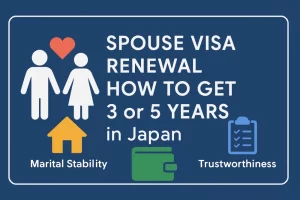
The period of stay is determined based on official notifications by the Ministry of Justice, but the actual duration granted depends on immigration screening. In this review, authorities place particular emphasis on factors such as marital stability, financial foundation, and proper payment of taxes and social insurance—in other words, stability, continuity, and credibility. At the initial stage, immigration often prefers to observe the situation, so most cases are granted only one year. However, if several years of stable life in Japan can be demonstrated, there is a higher possibility that a 3- or 5-year period will be approved at the time of renewal.
The authorities carefully assess three main aspects of your situation:
- Stability: Is your marriage stable and continuing?
- Continuity: Is your income, residence, and lifestyle consistent without gaps?
- Credibility: Are taxes and social insurance properly paid without issues?
3. Conditions for Being Granted 3 or 5 Years

So, what specific conditions need to be met in order to be granted a longer period of stay? Immigration authorities make a comprehensive assessment of each applicant’s individual circumstances, but broadly speaking, there are five key pillars of evaluation: marital stability, economic foundation, good conduct, renewal history, and life base in Japan. These factors can be summarized in the table below.
| Factor | Favorable Example | Unfavorable Example |
|---|---|---|
| Marital Stability | Married several years, living together continuously | Newly married, periods of separation |
| Economic Basis | Stable salary as a full-time employee, taxes and insurance fully paid | Unstable income, non-regular employment, unpaid taxes |
| Good Conduct | No criminal or repeated traffic violations | Multiple violations, tax delinquency |
| Renewal History | Several renewals without problems | Previous renewal required additional documents |
| Life Base in Japan | Long-term residence, family living together in Japan | Long overseas stays, weak ties to Japan |
Above all, stable marriage and stable income/tax compliance are the two most important factors.
4. Cases Where Only 1 Year Is Granted Repeatedly

Some applicants find that their renewals remain at 1 year despite multiple attempts. This usually occurs when immigration deems the situation not yet stable enough. Short marriage duration, periods of separation, or frequent overseas stays may raise questions about the marital relationship. Unpaid or delayed taxes and unstable employment also work against long-term permission.
Common reasons for 1-year renewals:
- Marriage duration is short (within 1–2 years)
- Unpaid or late tax/social insurance contributions
- Periods of separation or extended overseas stays
- Non-regular employment or unstable income after job changes
5. How to Prepare for a Longer Period of Stay

To obtain a longer period of stay, thorough preparation in daily life is essential. Submitting tax payment certificates and taxation certificates, and confirming enrollment in social insurance and the pension system, are the basics. In addition, attaching evidence of the marital relationship—such as photos, messages, or remittance records—can help demonstrate the stability of the marriage. Furthermore, providing the Japanese spouse’s certificate of employment or withholding tax slip will emphasize financial stability.
Practical preparation examples:
- Submit tax payment certificates and taxation certificates
- Ensure enrollment and payment of social insurance and pension
- Provide evidence of marital life: photos, messages, financial transfers
- Attach spouse’s certificate of employment and withholding tax slip
- Show a history of renewals without issues
Even if you are granted only 1 year once, the situation can improve in the next renewal if you steadily build credibility.
6. Relationship with Permanent Residency

Obtaining a 3- or 5-year spouse visa is closely tied to permanent residency. The general requirement for permanent residency includes holding a visa of at least 3 years. Therefore, once you are granted 3 years, you become eligible to apply. If you are granted 5 years, it serves as a strong indication of stability and significantly improves your chances of approval. For this reason, spouse visa renewals should be seen not just as routine procedures, but as strategic steps toward permanent residency.
7. Conclusion

To secure 3 or 5 years on your spouse visa renewal, you must demonstrate stability in your marriage, economic foundation, and social credibility. These are not conditions you can meet overnight, but rather results of consistent effort in daily life. Longer visa periods reduce the stress of renewals and open the door to permanent residency. By maintaining tax and insurance compliance, proving the marital relationship, and ensuring stable income, you will be well-prepared for future renewals and long-term residence in Japan.
Ishinagi Administrative Scrivener Office
“If you would like to obtain a spouse visa quickly and reliably, or if you feel uncertain about renewal or changing your residence status, please feel free to consult with our office in Yodogawa-ku, Osaka. We provide support for clients from all over Japan, making use of our experience in dealing with the Immigration Bureau.
If you wish to proceed with your spouse visa application smoothly and with confidence, please do not hesitate to contact us.
▶ Click here to see our fee schedule”
“▶ See our office’s fee schedule here”

Related Articles
▶︎ Thinking about applying for Naturalization in Osaka?|Ishinagi Administrative Scrivener Office

▶︎ Thinking about applying for Permanent Residency in Osaka?|Ishinagi Administrative Scrivener Office

▶︎ Thinking about applying for a Spouse Visa in Osaka?|Ishinagi Administrative Scrivener Office


Please contact us using the inquiry form below.
If you are in a hurry, feel free to call us at
06-7777-3467
(9:00 AM – 11:00 PM, Monday to Friday)
Please note that we may be unable to answer immediately if we are assisting other clients.
In that case, kindly leave a voicemail, and we will call you back as soon as possible.
About Our Privacy Policy
To learn about the privacy policy of “Ishinagi Administrative Scrivener Office,”
please refer to the link below:

Representative Administrative Scrivener: Takanori Ishinagi
Japan Federation of Certified Administrative Procedures Legal Specialists (Registration No.: 24260930)
Osaka Administrative Scrivener Association (Membership No.: 008905)
Certified Immigration Agent (Notification No.: Gyō-172025200093)
Neo Heights Shin-Yodogawa Room 406,
1-20-18 Jūsōhigashi, Yodogawa-ku, Osaka 532-0023, Japan
Feel free to contact us.
We will respond politely and clearly.
Business Hours: 9:00 AM – 11:00 PM (Monday to Friday)
Closed: Saturdays, Sundays, and national holidays
※ Email and LINE inquiries are accepted 365 days a year.
コメント