


Specified Skilled Worker (Nursing Care) vs. “Nursing Care” Visa: A Comprehensive Comparison
Comparing “Specified Skilled Worker (Nursing Care)” and “Nursing Care” Visa: Which is Best for Your Facility?
Securing foreign talent is becoming a vital strategy to solve labor shortages in Japan’s elderly care sector. However, many hiring managers find themselves overwhelmed by the variety of visa types. “Which visa is best for our facility?” or “The procedures seem too complicated…” are common concerns we hear.
In particular, the “Specified Skilled Worker (Nursing Care)” and the “Status of Residence: Nursing Care” are often confused due to their similar names. Understanding the differences between these two is the key to successful hiring and long-term retention.
In this article, as administrative scriveners specializing in immigration, we provide a clear comparison to help you choose the best option and map out a long-term career path for your staff.
The 4 Main Visa Types for Foreigners Working in Elderly Care
There are four primary categories under which foreign nationals can work in the Japanese care sector:
EPA, Student, Technical Intern, “SSW,” and “Nursing Care”
- EPA (Economic Partnership Agreement):
Candidates aiming to become Certified Care Workers based on bilateral agreements. This is a special framework with specific requirements for the receiving facility. - Student (Certified Care Worker Training):
Students studying at Japanese vocational schools. Upon graduation and obtaining the national license, they can switch to the “Nursing Care” visa. - Technical Intern Training (TITP):
Theoretically for “international contribution through skill transfer.” While common in the past, many are now transitioning to the “Specified Skilled Worker” system. - Specified Skilled Worker (SSW) & “Nursing Care” Visa:
These two are currently the most significant for facilities seeking immediate workforce and long-term core personnel.
Focusing on Today’s Two Mainstream Visas
While Technical Interns previously made up the majority, the trend is shifting toward SSW for practical reasons. Simultaneously, the “Nursing Care” visa is gaining importance for those seeking high expertise and permanent residency. Strategic facility management requires a clear understanding of these two.
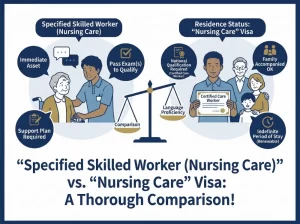
Thorough Comparison: “SSW (Nursing Care)” vs. “Nursing Care” Visa

The biggest differences lie in the “entry requirements” and the “future outlook.”
[Comparison Table] Requirements, Duration, Family, and Job Scope
| Item | Specified Skilled Worker (i) | Status of Residence: “Nursing Care” |
| Target Audience | Ready-to-work staff with basic skills. | Professionals with a National License. |
| Requirements | 1. Skill Exam (Nursing Care) 2. Japanese Exam (N4 level) | Must pass the National Exam for Certified Care Workers. |
| Period of Stay | Up to 5 years in total (※1). | Renewable indefinitely. |
| Bringing Family | Generally not allowed. | Allowed (Spouse and Children). |
| Job Scope | Physical care and support. (Home-visit services not allowed) | All caregiving duties. (Includes home-visit services) |
| Facility Obligation | Mandatory “Support Plan” implementation. | Standard employment management. |
| Path to Permanent Residency | No direct path (※1). | Possible in the future. |
(※1) Transitioning to “Specified Skilled Worker (ii)” may allow for family accompaniment and indefinite stay in the future, but current policies for the care sector are still evolving.
Which One Requires the National License (Certified Care Worker)?
As shown above, the defining difference is the National License.
- “Nursing Care” Visa: Requires the license. You must graduate from a Japanese training school or pass the national exam through work experience.
- Specified Skilled Worker: Does not require the national license. Instead, candidates must pass simpler skill and language exams.
Benefits and High Hurdles of the “Nursing Care” Visa

The “Nursing Care” visa is designed for professionals.
Benefits: Indefinite Stay and Family Accompaniment
- No Renewal Limit: As long as the employment continues, the staff can work in Japan indefinitely, providing a strong path toward Permanent Residency.
- Family Accompanying: Bringing a spouse and children to Japan is a massive incentive for talent to settle down long-term.
- Broader Job Scope: They can perform home-visit services alone, which offers more flexibility for your facility.
Hurdles: The Difficulty of the National Exam
The biggest obstacle is the National Exam for Certified Care Workers. Even for Japanese natives, the pass rate is around 70%. For foreigners, the specialized Japanese language barrier makes this a very high hurdle requiring significant time and effort.
Benefits and Cautions of “Specified Skilled Worker (Nursing Care)”

The SSW is designed to address immediate labor shortages.
Benefits: Easy to Hire Ready-to-Work Staff
- Broader Recruitment: Since no national license is required, it is easier to hire directly from overseas or transition staff from the Technical Intern program.
- Proven Skills: Candidates have already passed skills and language tests, ensuring a certain level of competency from day one.
Cautions: The 5-Year Limit and Support Obligations
- 5-Year Limit: Generally, SSW (i) holders can only stay for a total of 5 years. They must switch to a different visa (like “Nursing Care”) to stay longer.
- Support Plan Obligations: Facilities must provide extensive support (life orientation, Japanese language study, etc.), which requires time and cost.
- Job Restrictions: They cannot engage in home-visit services at this stage.
Conclusion: Mapping a Career Path for Long-Term Employment

Rather than choosing one over the other, it is important to combine them according to the staff’s growth stage.
The “Step-Up Strategy”: From SSW to National License
For many facilities, the following strategy is most effective:
- Entry via SSW: Hire talent through the accessible SSW program to meet immediate needs.
- Support Certification: While they work for 3 years, the facility actively supports their Japanese studies and national exam preparation.
- Switch to “Nursing Care” Visa: Once they pass the exam, switch their status to the “Nursing Care” visa.
This creates a Win-Win situation: the staff gains the hope of a long-term life in Japan with their family, and the facility secures a future leader and core member of the team.
Consult a Professional for the Best Hiring Plan

The best visa depends on your facility’s size, services, and the specific situation of the candidate. If you have questions like “What exactly is in a Support Plan?” or “How do I switch a Technical Intern to SSW?”, please consult an expert.
At Ishinagi Office, our administrative scriveners are well-versed in the elderly care industry. We offer total support, from proposing the best hiring plan to handling complex applications and building post-hiring support systems. Feel free to contact us for a consultation.
Ishinagi Administrative Scrivener Office
If you would like to renew or change your work visa quickly and reliably, or if you feel uncertain about the application process, please feel free to consult with our office in Yodogawa-ku, Osaka. We provide support for clients from all over Japan, making use of our extensive experience in dealing with the Immigration Bureau.
If you wish to proceed with your work visa renewal or change of status smoothly and with confidence, please do not hesitate to contact us.
▶ Click here to see our fee schedule
“▶ See our office’s fee schedule here”

Related Articles
Need to Renew or Change Your Work Visa in Osaka?|Ishinagi Administrative Scrivener Office

▶︎ Thinking about applying for Permanent Residency in Osaka?|Ishinagi Administrative Scrivener Office

▶︎ Thinking about applying for a Spouse Visa in Osaka?|Ishinagi Administrative Scrivener Office


Please contact us using the inquiry form below.
If you are in a hurry, feel free to call us at
06-7777-3467
(9:00 AM – 11:00 PM, Monday to Friday)
Please note that we may be unable to answer immediately if we are assisting other clients.
In that case, kindly leave a voicemail, and we will call you back as soon as possible.
About Our Privacy Policy
To learn about the privacy policy of “Ishinagi Administrative Scrivener Office,”
please refer to the link below:

Representative Administrative Scrivener: Takanori Ishinagi
Japan Federation of Certified Administrative Procedures Legal Specialists (Registration No.: 24260930)
Osaka Administrative Scrivener Association (Membership No.: 008905)
Certified Immigration Agent (Notification No.: Gyō-172025200093)
Neo Heights Shin-Yodogawa Room 406,
1-20-18 Jūsōhigashi, Yodogawa-ku, Osaka 532-0023, Japan
Feel free to contact us.
We will respond politely and clearly.
Business Hours: 9:00 AM – 11:00 PM (Monday to Friday)
Closed: Saturdays, Sundays, and national holidays
※ Email and LINE inquiries are accepted 365 days a year.
コメント